
Marshall County Arrest Records and Charges
An arrest record documents the arrest or booking event. It may identify the arresting agency, custody status, booking charge, bond information, and related jail details if the sheriff roster shows them. A court charge record starts when the prosecutor files formal charges in Marshall Circuit Court or a Marshall Superior Court. The filed charge, case number, court assignment, and later charge status are tracked in the court case.
The split matters. Booking language is not the final court outcome. The sheriff's release language in the research stresses that an allegation is not proof and that the person is presumed innocent until proof beyond a reasonable doubt. For custody details, use jail and sheriff channels. For the filed charge and case path, use MyCase and clerk records. For the full case file and final outcome, use the Marshall County criminal court records page.
Find Marshall County Arrest Records
Use more than one channel because an arrest and a filed court charge are different records. The sheriff's CentralSquare inmate portal is the custody route for current jail information. MyCase is the public case route once charges are filed. The prosecutor and clerk channels explain formal charging and copy access. A person arrested late in the day may appear in custody before a filed court case is visible.
- Check the official sheriff custody route if the question is current jail status or booking detail.
- Search Indiana MyCase by defendant name, case number, or citation number for filed court charges.
- Open the case and read each charge, code, offense level, and current status.
- Use the clerk copy process for charging documents, final orders, or certified records not linked online.
- Contact the prosecutor or court only for office-specific procedures, not for private legal advice.
The image from the Marshall County Prosecutor's Office marks the local office responsible for criminal charging decisions.
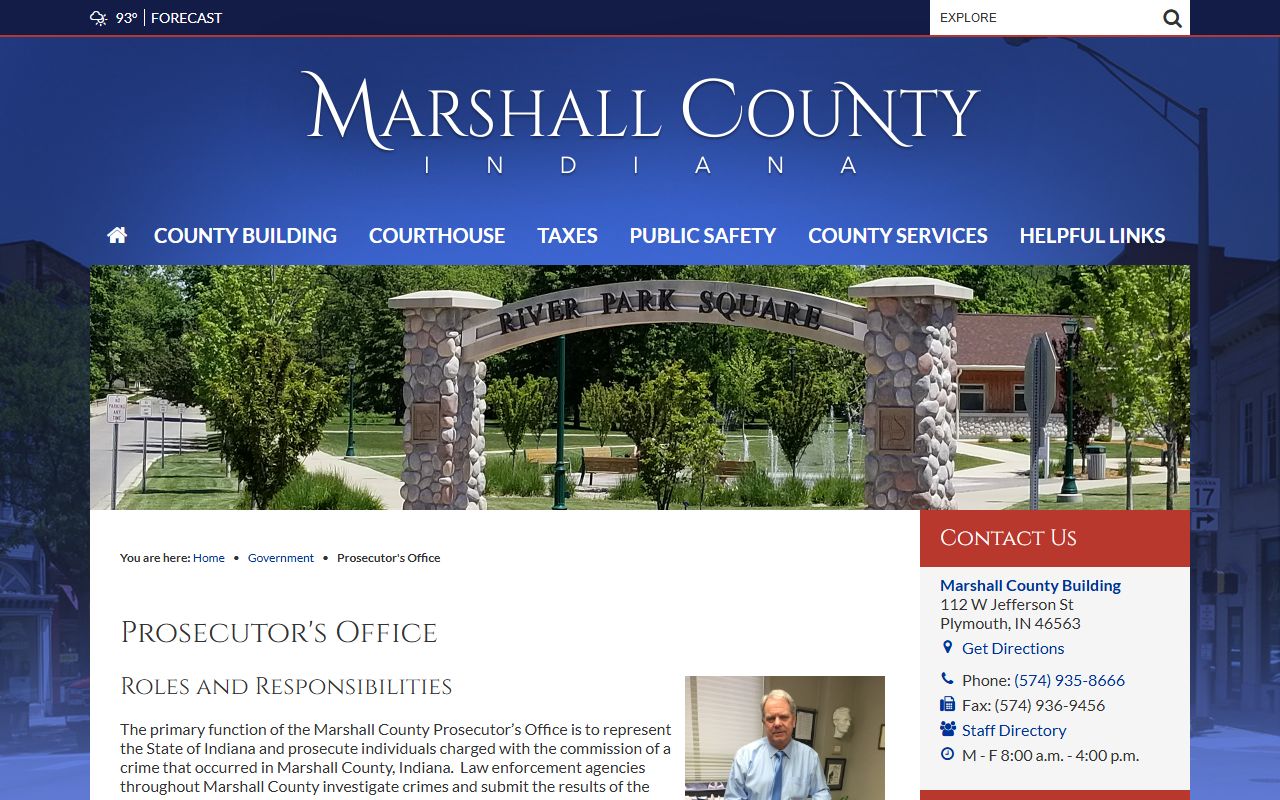
That office source is central to the arrest-to-charge path because police arrest and prosecutors decide what to file in court.
Charges After Arrest Documents
After an arrest, the prosecutor reviews reports, probable-cause material, and any available evidence before filing or declining formal charges. In Indiana local usage, the charging document is often called an information for prosecutor-filed criminal counts. A complaint may also appear in criminal or infraction contexts, and an indictment is tied to grand-jury charging. The research confirms that Indiana calls the local charging office the Prosecutor's Office, not a district attorney.
| Document | Who Files It | What It Starts | What To Check |
|---|---|---|---|
| Complaint | Officer or prosecutor depending on case type | A criminal, infraction, or complaint-and-summons route | Count, citation, summons, and required appearance or payment terms. |
| Information | Prosecutor | Many prosecutor-filed criminal cases | Filed charges, statute references, offense level, and amendments. |
| Indictment | Grand jury | A criminal case based on grand-jury action | Filed counts and later docket entries for plea, trial, or disposition. |
The prosecutor's local divisions include Child Support, Victim Assistance, Infraction Deferrals, Traffic & Misdemeanor, and Pretrial Diversion. Those divisions matter because some charges or infractions may be handled through diversion or deferral routes instead of a standard conviction path.
Marshall County Charge Status
Charge status can change during the case. A charge may be pending at filing, then amended to a different offense, reduced in a plea agreement, dismissed by the court, or resolved by conviction. Read the case docket and disposition for each count. One arrest can produce several counts, and each count can end differently.
| Status | What It Means |
|---|---|
| Pending | The charge has been filed and has not yet reached a final court outcome. |
| Amended | The prosecutor or court record changed the charge, wording, level, or count structure. |
| Reduced | The charge was lowered, often through plea negotiation or later case review. |
| Dismissed | The count or case was ended without a conviction on that charge. |
| Convicted | The record shows guilt by plea, verdict, or court finding. |
| Expunged or sealed | The public record is removed or restricted under law or court order. |
Do not read a booking charge as a final judgment. The final criminal case record is the better place to confirm whether the charge led to a conviction, dismissal, sentence, or expungement order.
Charges vs Convictions
A charge after arrest is a formal accusation. A conviction is the legal outcome that establishes guilt. This difference is the most important point in any Marshall County arrest records review. A person can be arrested, booked, charged, and later have one or more counts dismissed or reduced.
| Point | Charge | Conviction |
|---|---|---|
| Stage | After arrest or filing, before final outcome. | After guilty plea, verdict, or court finding. |
| Proof | Based on probable cause and charging rules. | Based on proof beyond a reasonable doubt or a valid plea. |
| Where shown | Booking detail, charging document, and MyCase charge list. | Disposition, judgment, sentence, and final case entries. |
| Meaning | An accusation that may change or be dismissed. | A final outcome with legal consequences unless later vacated or expunged. |
Marshall County Prosecutor Charges
The Marshall County Prosecutor's Office identifies E. Nelson Chipman, Jr. as Prosecuting Attorney for the 72nd Judicial Circuit. The office is listed at 112 W Jefferson St, Plymouth, IN 46563, phone (574) 935-8666, with weekday hours of 8:00 a.m. to 4:00 p.m. The prosecutor decides which formal charges to file after law enforcement reports an arrest or investigation.
The Indiana Prosecuting Attorneys Council Marshall County prosecutor page confirms the local prosecutor and contact information. The county staff directory also identifies Nicole Hite for infraction deferral and pretrial diversion at (574) 935-8624, which is relevant when a traffic, misdemeanor, or diversion-eligible charge follows a different path.
The image from the IPAC prosecutor page supports the official state listing for the local charging office.
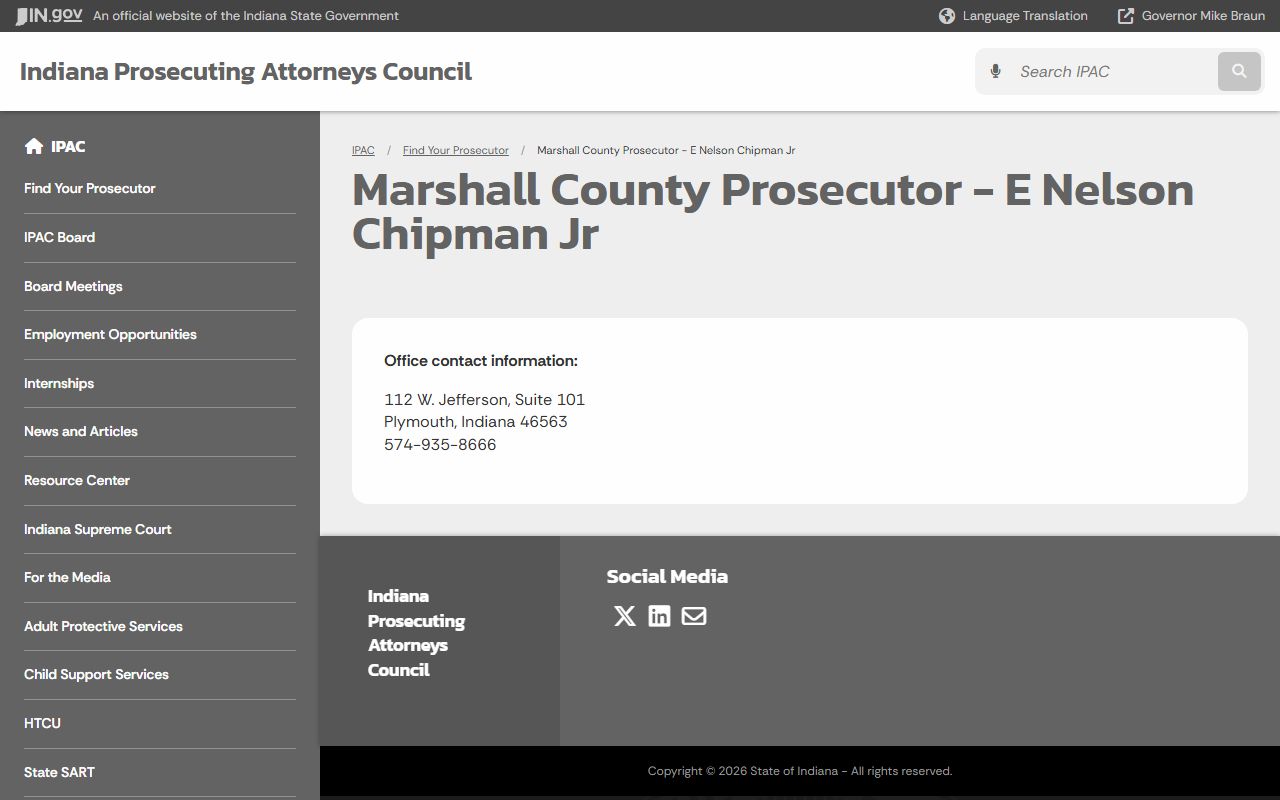
That state prosecutor listing reinforces that charging authority belongs to the prosecutor, not the jail roster or a private search site.
Charges, Diversion, and Corrections
Not every charge follows a simple arrest, conviction, and jail sequence. The prosecutor office lists Infraction Deferrals, Traffic & Misdemeanor, and Pretrial Diversion divisions. Marshall County also has Community Corrections material covering admission procedures and eligibility. These sources matter when a charge leads to supervision, diversion, community-based terms, or program eligibility instead of only jail or prison.
The image from the Marshall County Community Corrections board page supports the local supervision and program context.
Community Corrections is relevant after charges because court outcomes can include supervision and local program terms.
Sealed vs Expunged Charges
Indiana law allows some criminal records to be sealed or expunged. The practical workflow begins by identifying each case number and arrest agency. For Marshall County cases, search MyCase for public case numbers that remain visible, then request needed public copies from the clerk. If no charges were filed, the petition route may focus on the county of arrest. If charges were filed, the filing county matters.
| Point | Sealed | Expunged |
|---|---|---|
| Public access | Removed from ordinary public access by rule or court order. | Removed or restricted after statutory relief is granted. |
| Possible records | Juvenile, protected, confidential, or court-ordered sealed files. | Qualifying arrests, charges, juvenile allegations, or convictions under IC 35-38-9. |
| Public search result | May not appear or may show only limited data. | Usually not searchable as an ordinary public criminal case after relief. |
| Access after relief | Can still exist for authorized users. | Effect can differ for courts, law enforcement, and statutory employers. |
Restricted Marshall County Charge Records
Restricted charge records include juvenile matters, sealed cases, expunged charges, adoption-related records, mental health proceedings, and protected-person information. Protection-order cases are not found through ordinary MyCase searches because protected-person identifying information is excluded from online public access. Juvenile law also treats minors differently from adult criminal defendants.
Public does not mean instant or complete. A filed charge can be public while a probable-cause affidavit, personal identifier, protected victim detail, or juvenile-related document is withheld. If a charge is missing from public search, the reason may be confidentiality, expungement, delay, a different spelling, a different case number, or no formal charge filing after arrest.
Important: Use official sheriff, court, clerk, and prosecutor sources before relying on private background search results.